Deployment Models
ADITO offers two deployment options for operating the platform:
ADITO Cloud (SaaS)
In this fully managed SaaS model, ADITO hosts the platform for the customer, eliminating the need for self-operation or backup procedures.
- Hosted by on dedicated infrastructure.
- Includes regular backups, maintenance, and monitoring handled by ADITO.
- Scalable and updateable without user intervention.
This model is recommended for most customers.
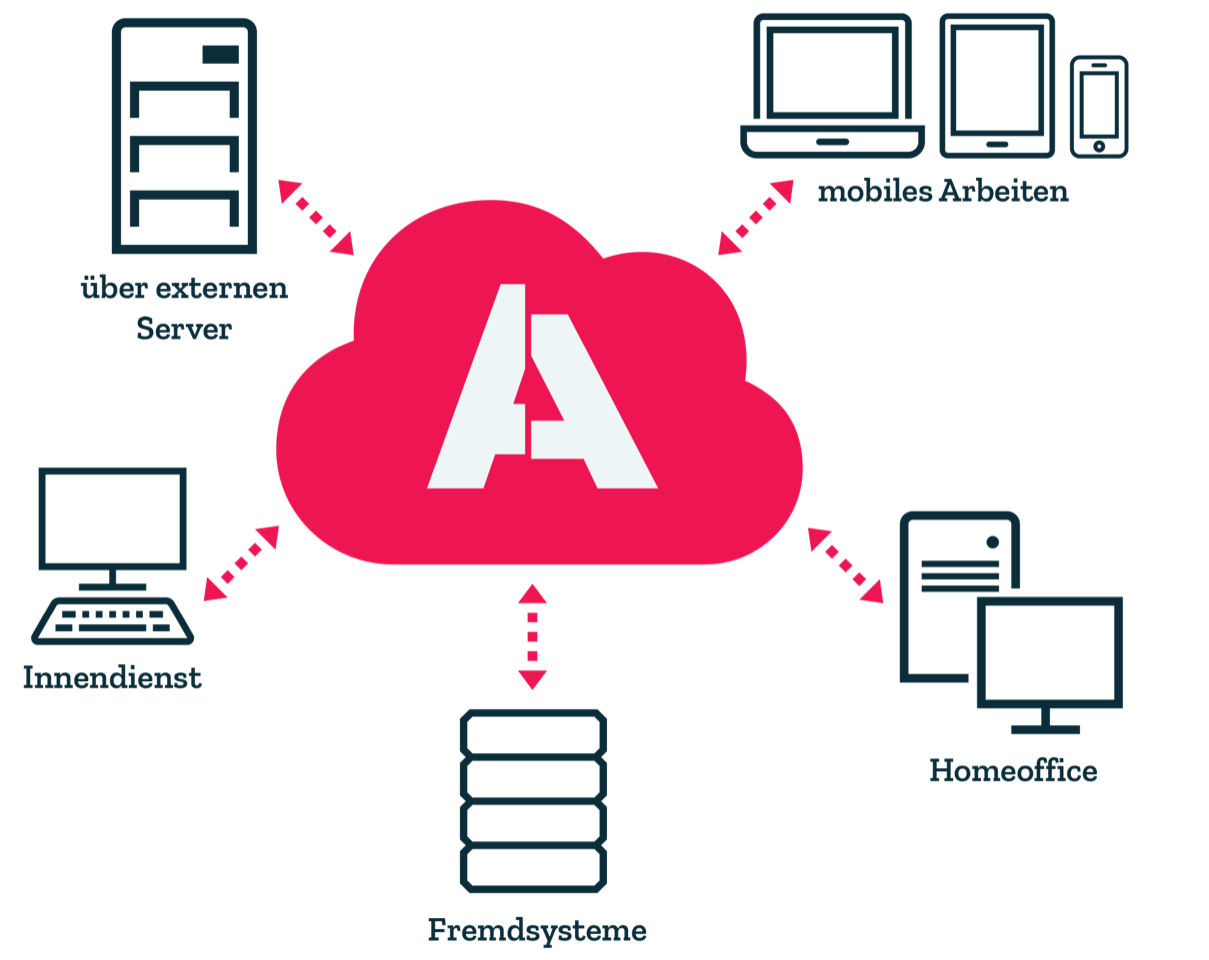
Figure: ADITO Cloud Infrastructure
ADITO Appliance (On-Premises)
The ADITO Appliance model provides a self-contained, containerized deployment suitable for installation in the customer’s infrastructure.
- Based on the same technology as the Cloud (Cloud-first approach).
- Supports high availability and scalability through container architecture.
- Operated by the customer, typically in a virtualized or on-premises environment.
This model is suitable for customers with regulatory or infrastructure constraints.
Access and Management Interfaces
Self-Service Portal
The browser-based Self-Service Portal enables project managers and system administrators to manage system operations centrally.
- Access to the ADITO Manager without VPN.
- Creation and administration of tenants in both Cloud and Appliance deployments.
- Monitoring of licenses, system resources, and usage statistics.
- User and role administration, including optional SSO support.
Available for both Cloud and Appliance users with different scopes.
Web Client
The ADITO Web Client runs in a standard web browser and communicates exclusively with the ADITO application. It is platform-independent and requires no additional software installation.
Communication occurs via encrypted WebSocket connections. The responsive UI automatically adjusts layout and rendering to fit the active device.
System Services
The ADITO platform consists of multiple technical services that operate together:
ADITO Application (Java Service)
- The core service is built in Java.
- A minimum setup includes two frontend and one backend server.
- Load balancing is used to ensure high availability.
- The service runs on OpenJDK 21, bundled for Windows and macOS, and requires manual installation on Linux.
Database Service
ADITO requires a relational database management system using SQL.
- The database server performance should be comparable to the application server.
- Memory requirements depend on configuration and workload.
- Storing binary files such as documents or emails within the database significantly increases storage requirements.
Index Service (Solr)
The platform uses Apache Solr for fast full-text search with relevance ranking. The search behavior is configurable and supports authorization filtering.
Workflow Engine (Flowable)
Workflows are executed using the open-source Java-based Flowable engine. Business processes are modeled in BPMN 2.0 via an integrated web editor.
E-Marketing Editor (Mosaico)
Mosaico is an open-source editor for creating responsive HTML email templates with live WYSIWYG editing.
Content Analysis (Tika)
Apache Tika is used to detect MIME types and extract metadata from uploaded documents, enabling correct indexing and rendering.
PDF Preview (IcePDF)
This service generates PDF preview images for display in the document tab of the client interface.
Text Analysis (Lucene)
Text analysis scores how well specified patterns match input texts, enabling fuzzy matching and pattern comparison.